
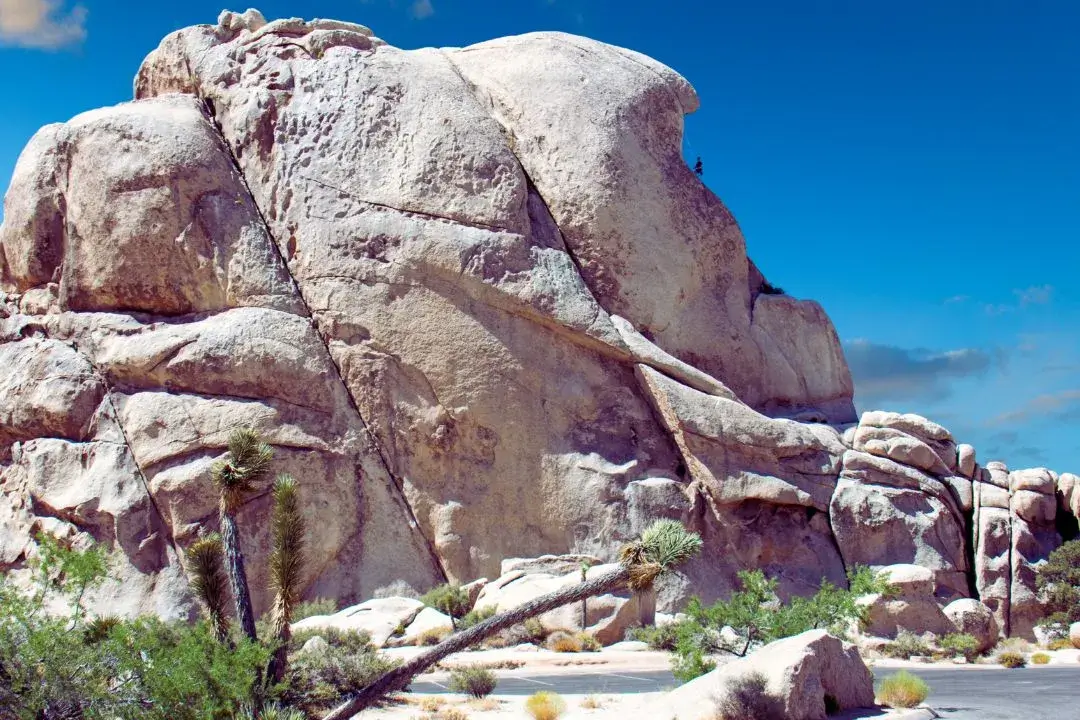
Standing about 150 feet tall at the entrance to Hidden Valley Campground, Intersection Rock is one of the most well-known climbing formations in Joshua Tree National Park. Located where Park Boulevard meets the Hidden Valley area, it also holds an important place in the history of climbing in Joshua Tree.
Intersection Rock is easy to access and has routes for a range of climbing abilities, but don’t let its popularity fool you. Some routes are more challenging than they look from the ground, and knowing what to expect can make a big difference.
In this guide, we’ll cover the main climbing routes and grades, what to expect when climbing Intersection Rock, how the descents work, the best times to climb, and the Joshua Tree National Park rules you should know before you go.

Why Climbers Keep Coming Back to Intersection Rock
One of the biggest reasons climbers return to Intersection Rock is how easy it is to get to. From the parking area, it’s only about a two-minute walk to the base. There’s no long approach or steep hike with a heavy climbing pack, which is especially convenient when you’re carrying ropes and gear.
Its location is another big part of its appeal. Intersection Rock sits where several roads and areas of the park meet, which is where it gets its name. It’s also one of the first major climbing formations you’ll come across when entering the Hidden Valley area, making it a natural starting point for many climbers.
The rock itself is quartz monzonite, although you’ll often hear people simply call it granite. Its rough, coarse texture provides plenty of grip, especially on the slabs and faces, but that same texture can be tough on your hands.
One formation packs a surprising variety of climbing. You’ll find cracks for hand and foot jams, open faces that require balance and precise movement, chimneys where you can use your whole body, and lower-angle slabs. The north side is steeper and faces toward the parking area, while the south side offers more moderate terrain with plenty of natural features to work with.
Routes on Intersection Rock, by Grade
Climbing routes at Joshua Tree are rated using the Yosemite Decimal System (YDS). Most routes start with 5, which indicates technical rock climbing, while the number and letter that follow describe the difficulty. For example, a 5.3 is relatively straightforward, while a 5.11a requires considerably more climbing skill and technique.
You’ll also see the term pitch when looking at route descriptions. A pitch is roughly one rope length of climbing. On a two-pitch route, climbers reach a point partway up the formation, build an anchor, and bring the other climber up before continuing to the next section.
| Route | Grade | Pitches | Character |
| Upper Right Ski Track | 5.3 | 1 | The classic beginner line on the formation; a genuinely rare starred 5.3 |
| Beginner’s Three | 5.3 | 1 | A short hand crack at the southwest end |
| Mike’s Books | 5.6 | 2 | Popular moderate; the second pitch runs wide |
| Bat Crack | 5.6 | 2 | One of the oldest routes here; chimney and crack, with face holds available |
| Overhang Bypass | 5.7 | 2 | The most popular route on the formation; skirts North Overhang |
| The Flake | 5.8 | 2 | One of Joshua Tree’s most sought-after 5.8s; rewards varied technique |
| North Overhang | 5.9 | 1 | A true classic, for experienced leaders — not a beginner objective |
| Left Ski Track | 5.11a | 1 | Where the formation stops being friendly |
A Common Route Mix-Up
There’s one common mistake worth clearing up. You’ll see The Bong (5.4) listed as an Intersection Rock route on quite a few websites, but it’s actually located on The Blob, a separate formation just a short walk away in Hidden Valley Campground.
The Bong is a popular beginner-friendly trad route and is often recommended as a first trad lead. It’s also a route we regularly use on our private rock climbing tour in Joshua Tree. Just keep in mind that it isn’t on Intersection Rock itself.
How Hard Are the Climbs, Really?
Joshua Tree climbing can feel harder than the grades suggest. The park is known for its old-school grading, and a route that looks easy on paper can feel quite different from the same grade in a modern climbing gym.
There are a few reasons for this:
- Most routes are traditional climbing : In a gym, bolts are already fixed to the wall and you simply clip your rope into them as you climb. On a traditional, or “trad,” route, the lead climber places removable protection into cracks along the way and removes it afterward. Knowing how to place gear correctly and build a safe system takes experience and practice.
- Some routes are multi-pitch : Instead of climbing the entire route in one rope length, you may stop partway up, build an anchor, bring your partner up, and then continue to the next section. Managing the rope, anchors, and transitions becomes part of the climb.
- The climbing style can also be very different from what you’re used to : Joshua Tree is known for cracks, slabs, chimneys, and rough textured rock. Techniques like hand jamming and chimneying may be completely new to someone coming from a gym. Even experienced gym climbers can find an easy-looking Joshua Tree crack surprisingly challenging.
That doesn’t mean Intersection Rock isn’t a good place to start climbing outdoors. In fact, its easy access and variety of routes make it a great introduction to Joshua Tree. The key is choosing a route that matches your experience and having someone with the right outdoor climbing skills to guide you through the systems.
For first-time visitors, a private or small-group guided climb can be a great way to learn how outdoor climbing in Joshua Tree actually works while focusing on the climbing rather than trying to figure everything out on your own.
Getting Down: Descents and Rappels
There are two main descent options from Intersection Rock: rappelling or downclimbing/scrambling, depending on the route.
Rappelling: Intersection Rock has fixed rappel anchors at the top of several routes. Depending on the route and rope length, the descent may require multiple rappels, with the rope being reset at an intermediate station.
Downclimbing and scrambling: Some routes allow climbers to descend on foot rather than rappel. The exact descent depends on the route and may involve exposed scrambling or technical downclimbing.
The appropriate descent method depends on the route, conditions, rope length, and the equipment and experience of the climbing party. If you’re planning to climb Intersection Rock and aren’t familiar with the descent, climbing with an experienced partner or professional guide can make the experience much more straightforward. On our guided rock climbing tours in Joshua Tree, we handle the anchors, rope work, and descent so you can focus on enjoying the climb.
When to Climb Intersection Rock
Fall and spring are best. Daytime temperatures typically sit around 60–75°F, close to ideal for rock in full sun. Clear, windless winter days work well too, and the crag is far quieter.
Avoid summer. The rock is exposed, the heat is severe and there’s very little shade at the base. If you must come, go early morning or evening.
Aspect matters more than people expect. The north face — the one looking at the parking lot — takes less direct sun and stays more comfortable. The south and west sides catch the afternoon and get genuinely hot to the touch in warm months.
Intersection Rock also stands alone and catches the wind. A breeze that feels pleasant in the car park can be cold and unsettling 100 feet up.
Where Intersection Rock Is and How to Get There
Intersection Rock is located along Park Boulevard, about nine miles from the West Entrance of Joshua Tree National Park. You may also see older guidebooks refer to this road as Quail Springs Road. It’s the same road, just an older name.
The road around Intersection Rock has been re-routed, so older descriptions may not match the approach you see today. If a guidebook seems to describe the formation from a different direction, this is usually the reason.
There is a paved parking area and restrooms near the formation. Intersection Rock is visible from the road, and you can easily walk around its base without climbing.
Hidden Valley Campground as a Climbing Base
Hidden Valley Campground is located just a short walk from Intersection Rock, making it a convenient base for climbers who want to spend several days exploring the area.
From the campground, you can walk to several well-known climbing formations, including The Blob and The Old Woman, along with many other routes throughout Hidden Valley. Staying nearby also means you can get to the rock early without having to drive and can easily move between different climbing areas if a route is busy.
Hidden Valley Campground is especially popular with climbers during the cooler months, so campsites can fill quickly.
Climbing Rules and Seasonal Closures
Joshua Tree’s climbing regulations are set out in the park’s Superintendent’s Compendium. Three matter most:
- Vegetation cannot be used as an anchor. Desert plants here are slow-growing and easily killed.
- Only neutral or rock-coloured bolt hangers are permitted, so hardware doesn’t stand out against the stone.
- A permit is required to add or replace a bolt. This isn’t something to do on your own initiative.
There are also seasonal raptor closures. Each spring, owls and falcons nest on the park’s formations, and when a nest sits near climbing routes the park closes them until the birds move on. Which routes are affected changes every year, and so do the dates.
So check current closures shortly before you travel rather than trusting any website’s list, including this one. The National Park Service publishes live status on its climbing closures page.
Climbing Intersection Rock With a Guide
Intersection Rock is a superb introduction to climbing in Joshua Tree and a poor place to improvise. Short approach, genuinely good classic lines, and the setting people picture when they think of this park. What it asks in return is gear, rope skills and a plan for the descent.
If you’d rather climb it without assembling all that first, that’s what a guided day is for. And if you’re still deciding where to spend your time, our guide to the best climbing routes in Joshua Tree covers the other formations worth knowing.
FAQs
Is Intersection Rock good for beginners?
Yes, with a caveat. It has genuine beginner routes such as Upper Right Ski Track (5.3), but the grades are stiff and most routes are traditional and multi-pitch. It’s an excellent first outdoor day with someone experienced, and a demanding place to work out alone.
How tall is Intersection Rock?
About 150 feet.
Can you top-rope at Intersection Rock?
On some lines, yes. Top-roping means the rope runs from you up to an anchor at the top and back down to whoever is holding it, so a fall is short. The catch: someone must reach the top first and build that anchor, which is not a beginner task.
What is the easiest route on Intersection Rock?
Upper Right Ski Track (5.3). Beginner’s Three, also 5.3, is the other option.
Where do you park for Intersection Rock?
In the parking area at Hidden Valley Campground, just off Park Boulevard. There are restrooms on site.
Do I need a permit to climb at Intersection Rock?
No permit is needed to climb, but follow the Compendium rules above and check current seasonal closures before you go.